
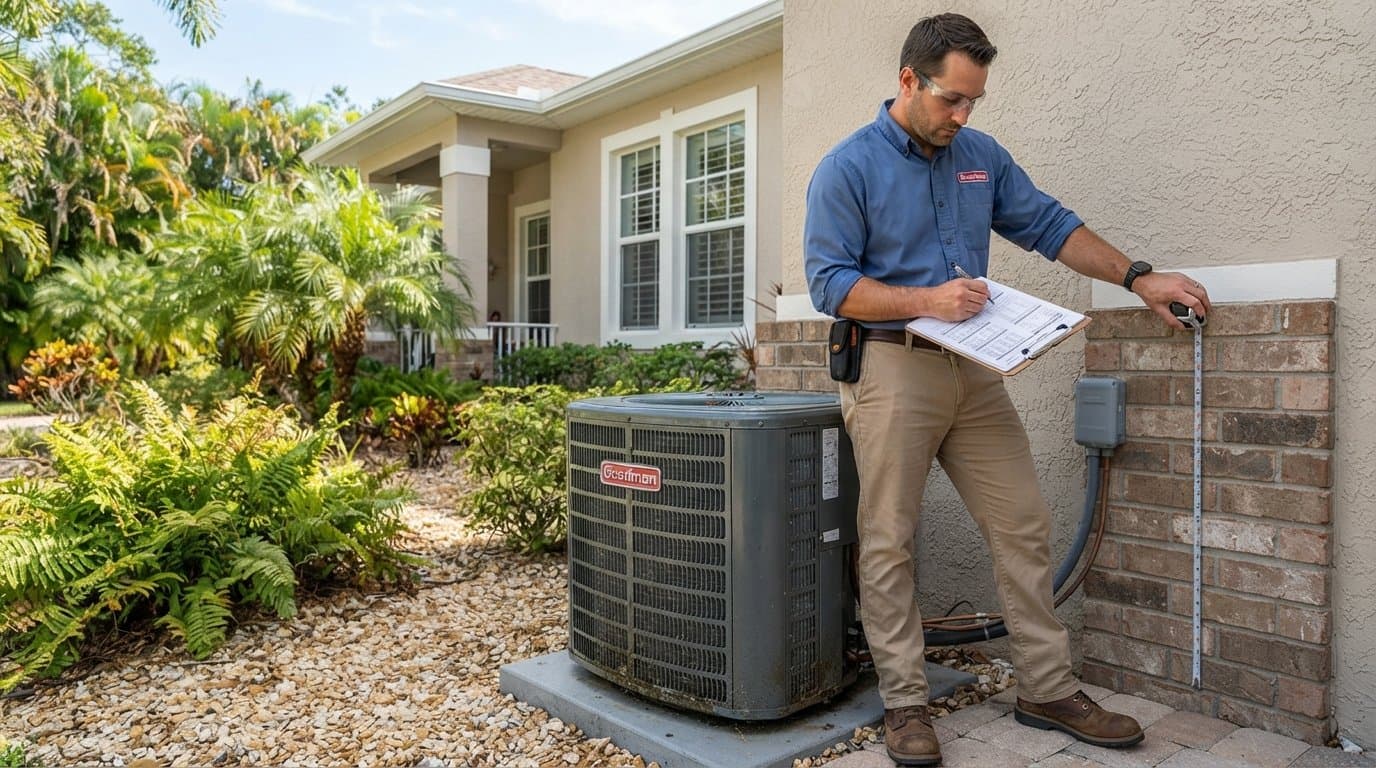
Every summer we replace a system that a previous contractor oversized "just to be safe." The homeowner is confused — bigger AC should cool better, right? — but the room is muggy, the compressor short-cycles every seven minutes, and the power bill somehow climbed after the new install.
Here's what actually goes wrong when an AC is oversized in Florida, and how to make sure it doesn't happen to your next system.
The rule of thumb everyone uses is wrong
"400 square feet per ton" is the number floating around Florida trucks. It's a starting point, not a spec. In practice, a 2,000 sq ft Port Orange home might need anywhere from 2.5 tons to 4.5 tons depending on:
- Attic insulation depth and radiant barrier
- Window area, orientation, and glazing (single vs double)
- Ceiling height and volume of interior space
- Duct condition and leakage rate
- Internal loads (people, appliances, electronics)
- Solar exposure and shade
That's why every proper HVAC quote in Florida should start with a Manual J load calculation — the industry-standard heat-gain calculation from ACCA.
Why oversizing hurts, especially in Florida
An AC does two jobs: it removes heat, and it removes moisture. Moisture removal happens over time — the coil condenses water as air passes over it. A properly sized system runs long enough to pull the humidity down. An oversized system cools the air fast, hits the thermostat setpoint, and shuts off before it removes much moisture.
Result: your thermostat reads 74° but your house feels like 80°. That's "cold and clammy" — the classic sign of an oversized system in a humid climate.
The other consequences:
- Short-cycling. Frequent starts wear out the compressor faster and burn extra power on startup.
- Uneven cooling. Rooms furthest from the air handler don't have time to catch up before the unit cycles off.
- Higher installed cost. You pay more for equipment you can't use.
- Higher operating cost. Efficiency ratings drop off at low run times.
What a proper Manual J looks like
A load calc takes 30–90 minutes on-site for most residential homes. Your contractor should:
- Measure the conditioned square footage room by room.
- Note wall construction, insulation, and window specs.
- Verify duct condition (leakage is often 25%+ on older systems).
- Ask about internal loads and occupancy.
- Deliver a written report with the calculated cooling and heating loads.
If someone quotes you a tonnage after walking around the house for ten minutes, that's not sizing — that's guessing.
Sanity checks for Central Florida homes
For most Volusia County homes we install between:
- 1,200 sq ft: 2.0–2.5 ton
- 1,800 sq ft: 2.5–3.0 ton
- 2,500 sq ft: 3.0–3.5 ton
- 3,500 sq ft: 3.5–4.5 ton
- 4,500 sq ft: 4.5–5.0 ton (often two zones)
Numbers vary widely with insulation and window package — but if you're being quoted a 5-ton for a 2,000 sq ft home, ask to see the Manual J.
The bottom line
Right-sizing your AC saves money three times: on install, on operating cost, and on comfort. If your contractor won't do a Manual J, find one who will.
Northgate does a full Manual J on every install quote. It's not a premium service — it's just how we do it.
Ready for a properly sized quote? Schedule an in-home estimate and we'll take the measurements before we quote the tonnage.