
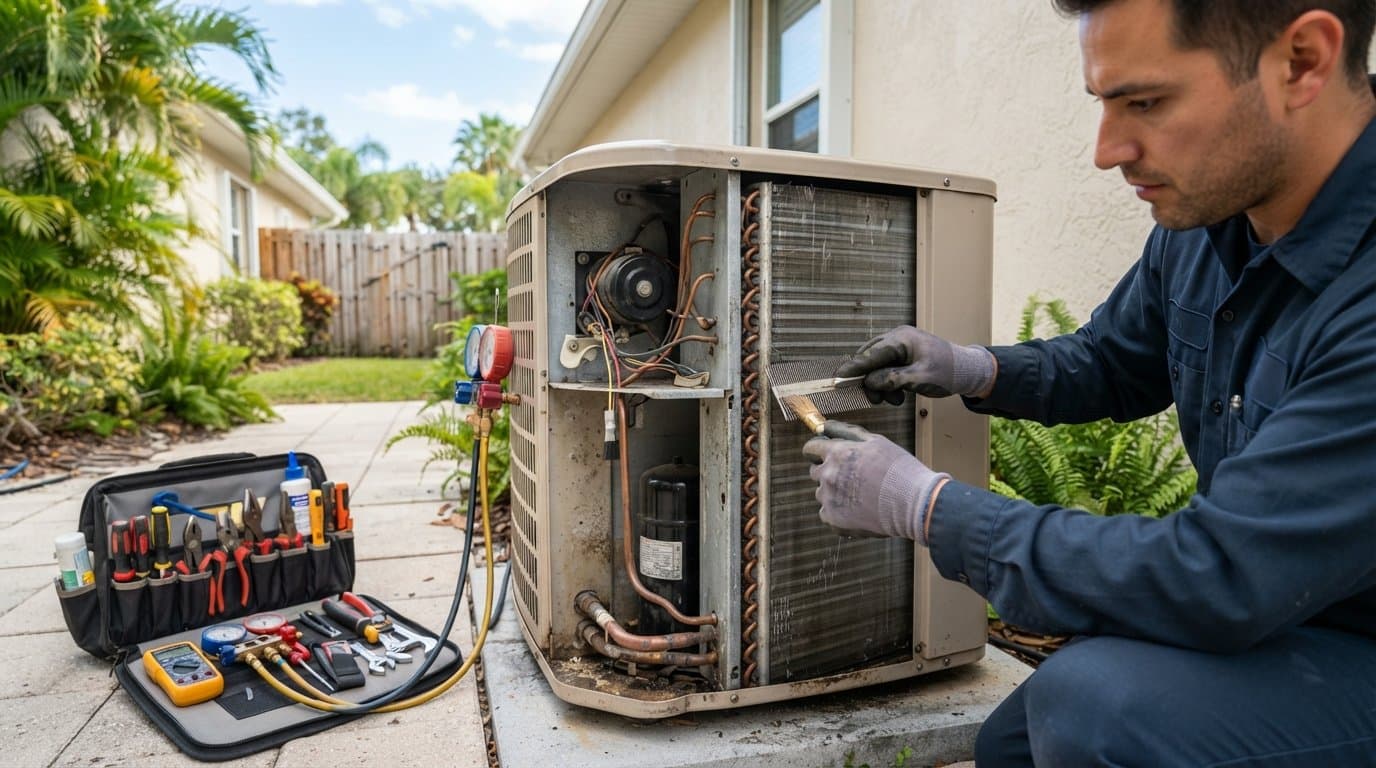
"Sign up for our maintenance plan!" is the closing line of nearly every service call in Florida HVAC. And most homeowners quietly ignore it — because they've been burned by "tune-ups" that were 20 minutes of hose-spraying and an invoice.
Here's what a real tune-up looks like, why it actually prevents breakdowns, and how to tell if a plan is worth the money.
The list a real precision tune-up should include
If a tech is on-site for less than 45 minutes, they didn't do the full checklist. Here's ours:
- Static pressure test across the coil and filter — reveals airflow restrictions before they choke the system.
- Blower motor amp draw — a motor drawing high amps is on borrowed time.
- Capacitor microfarad test — the #1 cause of summer no-cool calls. A capacitor at 20% below spec fails inside 12 months.
- Contactor inspection — pitted contacts arc, then weld, then fail.
- Refrigerant superheat / subcool — verifies the refrigerant charge is correct (not just "there's pressure").
- Evaporator coil rinse or brush — clean coil = 10–15% efficiency gain.
- Condenser coil rinse — critical in coastal / salt-air homes.
- Condensate drain flush + safety switch test — the leading cause of ceiling damage.
- Thermostat calibration — usually a two-minute check that saves a service call.
- Electrical connection tightening — loose lugs are a fire risk.
Written report + photos should follow every visit.
Why this actually prevents breakdowns
About 80% of summer no-cool calls in Central Florida fall into four buckets:
- Failed run capacitor (~35%)
- Low refrigerant charge from a slow leak (~20%)
- Blocked condensate drain (~15%)
- Dirty coils / high static pressure (~10%)
Every one of those is catchable at a proper tune-up. That's not marketing — it's the diagnostic pattern we see every June.
What a plan should actually include
Look for:
- Two visits per year. One before cooling season (spring), one before heating (fall). Florida's "heating" is mild, but tune-ups still catch defrost issues on heat pumps.
- Priority scheduling. In July, this matters. It's the difference between "same day" and "Thursday."
- No after-hours dispatch fee. A real member perk.
- Repair discount (typically 10–15%).
- Loyalty credit toward replacement.
- Transferable to buyer if you sell your home.
What to skip
- Plans that only include one visit per year.
- Plans that don't include a written report.
- "Free" plans that make money by upselling every visit.
Is it worth it for your home?
The math is simple. A tune-up is $89–$150 out of contract. Two of them a year plus a modest discount and no after-hours fee usually breaks even at one small repair. If your system is 5+ years old and you live in a summer-humid climate, that's not a maybe.
Our Comfort Club is $22/mo. Typical member saves $180–$400/yr. Not our idea of aggressive marketing math — it just works out that way because we'd rather keep our systems running than replace them prematurely.